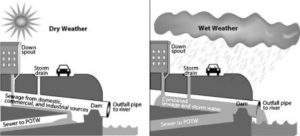
In older cities such as Springfield, sewer systems were constructed to collect and transport sewage and stormwater together in one pipe. These are called “combined sewers.” There are approximately 150 miles of combined sewer pipes in Springfield, mostly in older neighborhoods.
The Commission owns and maintains all sewer mains throughout Springfield. The City of Springfield DPW owns and maintains the stormwater system. This includes the storm drains/grates on the streets.
During some rain events, combined sewer pipes are designed to discharge into waterways when they become filled with stormwater. These discharges are known as combined sewer overflows, or CSOs. View an interactive map or sign up for automated notifications of recent CSO notifications at springfieldalerts.com.
What are CSOs?
Source: U.S. EPA
During rain events, the rain runoff (or "stormwater") from the streets can overwhelm the capacity of the combined sewer mains. To prevent this excess capacity from backing up into streets or basements, the systems were designed with outfalls that empty into waterways. Each discharge event into a waterway is known as a "combined sewer overflow," or CSO.
Why are CSOs important?
There are 24 combined sewer outfalls in Springfield's combined sewer system. During some rain events, these outfalls discharge CSOs into the Connecticut, Mill, and Chicopee Rivers. While combined sewer outfalls perform just as they were originally intended - to prevent backups into streets and buildings - they also allow diluted but untreated wastewater to enter waterways.
In 1994, EPA began to regulate CSOs across the country to improve environmental water quality. The Commission has been working ever since under various EPA Administrative Orders to reduce the amount of CSOs as much as possible, while maintaining affordable rates. CSO reduction is a substantial part of the Commission's capital and operations budget.
The Commission's CSO Program
Since the 1990s, the Commission has spent approximately $300 million on CSO reduction projects, resulting in an approximate 50% reduction in CSO volume. The cost of designing and constructing CSO reduction projects is very high, and eliminating CSOs is expected to take several more decades to achieve.
To balance its CSO projects obligations with other necessary projects, the Commission developed and adopted one of the country's first Integrated Wastewater Management Plans (IWP) in 2014. The IWP features a 40-year Capital Improvement Program for CSO reduction and other wastewater functions.
The result of the IWP is projects designed to meet multiple objectives at once, such as the York Street Pump Station and Connecticut River Crossing Project. That project, which was completed in 2023, replaced an aging pump station with a new one with twice the pumping capacity. This additional pumping capacity allows more combined wastewater/stormwater to be pumped to the wastewater treatment plant during storm events, reducing CSO discharges. In addition, three new pipes across the Connecticut River added redundancy to the two existing 85-year-old pipes. The old pump station will also be re-purposed into a flood control pump station. Thus this one project addresses the issues of aging infrastructure, CSO remediation, system redundancy, and resiliency all at once.
Other Ways to Reduce CSOs
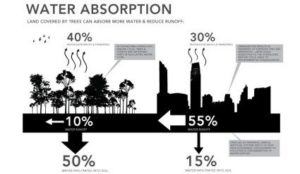
When rain falls on heavily developed areas like Springfield, most of it hits surfaces such as roofs, pavement, and sidewalks, which do not absorb it. In areas with combined sewer systems, that water will eventually drain from the street into a combined sewer pipe, and can contribute to CSO discharges.

One way to reduce CSOs is to reduce the amount of stormwater entering a combined sewer system in the first place. This can be helped by property owners installing features on their property that catch and hold or absorb stormwater during rain events:
- Trees! Trees are perhaps the most beautiful features of any landscape, and are a cost-effective and environmentally beneficial way to reduce CSOs. They do this by catching rain on their leaves, stems, branches, and roots, which slows down the water long enough for it to evaporate into the air or soak into the ground. Springfield has 31,000 trees that intercept 48,000,000 gallons of water and can save up to $382,000 on water usage. (Learn more about how trees help with runoff here.) Re-Green Springfield is a local organization that offers resources and programs to help Springfield residents and businesses plant trees on their property.
- Rain barrels are containers that catch stormwater running off roofs or other structures during storm events, to be used later for low-cost irrigation. Rain barrels to catch stormwater are generally inexpensive to make, purchase, or install, and can also come in larger cistern sizes. The Commission sells discounted rain barrels to its customers every spring.
- Green infrastructure is landscaping that is designed to catch, absorb, or convey stormwater using natural materials such as soils and plantings, and also pervious paving materials that allow water to infiltrate into the ground. There are several examples of green infrastructure throughout the Pioneer Valley.